Site-Logo
Site Navigation

All posts for tag: Mideast

Ice broken also in Germany
20/12/2010 · Wilhelm Langthaler
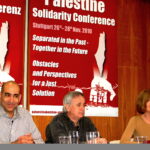
Ali Abunimah, Ilan Pappé and Sophia Deeg
The conference was a breakthrough not only regarding the number of participants but first of all because of its quality. It indicates a political shift which in most western countries is already in full swing. The two-state solution is being recognized more and more not only as deception and farce but as an outright support for Israeli apartheid. This change is due to the dramatic impact of the continuing blockade of Gaza, the Israeli military aggression on Gaza in January 2009 as well as the massacre on the Gaza freedom flotilla. Outstanding orator was Ilan Pappé, an Israel historian teaching in England. He was setting the line: A Jewish state cannot be other than colonial oppressing the Palestinians. There is no such thing as progressive Zionism. On the contrary Pappé compared … [read more]
Stuttgart declaration
16/12/2010 · Stuttgart, 26-28 November 2010
Equality – or nothing (Edward W. Said) The speakers were the Israeli historian Prof. Ilan Pappé from the University of Exeter (U.K.), Prof. Haidar Eid from the Al Aqsa University Gaza, Prof Mazin Qumsiyeh from Bir Zeit University Ramallah, the co-founder of the Internet Portal Electronic Intifada Ali Abunimah, the Palestinian activist Lubna Masarwa, the international law expert from Hamburg Prof. Norman Paech, the journalist and human rights activist Evelyn Hecht-Galinski, Annette Groth MP from the parliamentary fraction of the left party (DIE LINKE), lawyer Jörg Lang, and Attia Rajab and Verena Rajab from the Stuttgart Palestine Committee. The jazz musician Gilad Atzmon supported the conference with his welcome address. The actress Julianna Herzberg and Samir Mansour with his … [read more]
“Most important thing Palestinian unity”
12/12/2010
Maryam Abu Dagga was interviewed be the Intifada Magazine during her participation in the 9th International Symposium against Isolation, held in Vienna on December 4-5, 2010. Intifada: Recently you spoke in different meetings and forums in Berlin, Copenhagen and other European cities. What is your impression of the European solidarity movement? Maryam Abu Dagga (M.A.D): First of all thank you for this meeting. Living in Gaza under the siege is very hard, and after the war our suffering and problems have gotten worse, especially for the people of our party. We have many problems and many difficulties to move. So it is only at very few times that we have the possibility to meet people internationally to speak about our problems. This occasion is very important for me and for the … [read more]
Leila Khaled on 10 yrs Intifada
26/10/2010 · Leila Khaled
Bild
Brothers, Sisters and comrades, I am glad and honoured to be addressing you for this event. I would like to tell you that from the start of our Palestinian revolutionary movement, we knew we were not alone, that our struggle was part of the international struggle. This makes us continue our struggle without fear in facing zionism and imperialism, especially US imperialism, as we know people around the world are with us practically and not just theoretically. We have learnt from history that when a people is occupied and oppressed they will revolt to liberate themselves using all methods including armed struggle, which is also enshrined in the UN Charta. Our homeland has been occupied since 1948, and I Leila Khaled have been a refugee for 62 years like 6 million other … [read more]
Anti-Kurdish mass trial in Diyarbakir
20/10/2010 · UK observer delegation
Press Statement from UK Delegation in Diyarbakir to observe the trial of 151 Kurdish political activists and human rights defenders: We, as delegates from Britain of varying backgrounds and ethnicities welcome the opportunity that has been afforded to us to have firsthand insight into these historic trials. During our observations thus far we have had the opportunity of meeting and speaking with Mayors, Parliamentarians, Lawyers, Academics and many other interested parties. This has given us the opportunity to explore at firsthand the issues in these trials and have helped to shape our understanding of the actual meaning of these trials. We had firsthand experience of being in the Courtroom with the 151 defendants and their 250 lawyers yesterday and today. We can confidently … [read more]
In the same trench with anti-imperialist and marxists
16/10/2010
Sumud: Can you give us some basic information on Hezbollah? Ali Fayyad (A.F.): Let me introduce myself first. I am now a member of the Lebanese Parliament, I am in the Political Bureau of Hezbollah and I am a professor at the Lebanese university where I teach Sociology of Politics. From 1982 until 1990, I was responsible for the students' and teachers' sector of the Hezbollah. After that from 1990 until 1994 I was the Hezbollah responsible for the media (TV, radio, newspapers etc.). Then, from 1995 until one year ago I was the General Director of the Consultative Center for Studies and Documentation, the think tank of Hezbollah, so for fourteen years. But when I got my seat at the Parliament I left my position here at this Center. So today I am only a professor at the university and an … [read more]
Trial of A Makhoul enters new phase
5/10/2010
Bild
Makhoul’s lawyers further secured a ruling from the Nazareth District Court, September 14th, upholding Makhoul’s right to direct and confidential access to counsel. Makhoul’s right to counsel as a citizen of Israel had been routinely violated by prison authorities, who had been officially and conspicuously wire-tapping his conversations, conducted across glass barriers via telephone, with his lawyers. Background Sixteen members of Israel Security Agency, commonly known in English as the Shin Bet, abducted Mr. Makhoul from his home at 3:00 am on May 6th, 2010. They searched his home and office, seizing personal items belonging to Makhoul and his family, as well as office equipment, documents and databases. Makhoul was detained incommunicado. A sweeping “gag order” was … [read more]

What is behind Abbas’s decision to negotiate?
20/9/2010 · Adel Samara
During the first era of the occupation 1967-1993, the Zionist occupation imposed a plan of shattering and terminating the productive structure of WBG economy, confiscating land for its colonies, closing large farming areas for its military training, dumping the local market with its products and cutting all export import links with other countries, a policy that made the local economy captive to the occupation economy. The occupation destructive policy continued during the second stage of the occupation (1993 until today) under the Palestinian Authority (PA) regime which contributes to the deepening of the crisis but in a different manner. Israeli terminating policy of the first era which continued through the second era is essentially a de-development policy that has made the social … [read more]
“A common state of Muslims, Christians and Jews without Zionism”
2/9/2010 · by Mohamed Aburous
Abu Obaida Shakir
Founded in 1983 the “Islamic Jihad” (IJ) has been the first Islamic organisation which took up arms and joined the struggle for the liberation of Palestine. It offered the first Islamic alternative to the secular project of Arafat even before the Muslim Brotherhood created Hamas and embarked on the armed struggle. The political difference between IJ and Hamas is that the first puts national liberation before the Islamisation of society. Inspired by the Islamic revolution in Iran its founder Fathi Shikaki (born 1951 and assassinated 1995 in Malta) absorbed many social and political elements not only from Shiite political Islam but also from the secular left and the Pan-arabist movement. His book “Khomeini: The Islamic Solution and the Alternative” which appeared in 1979 can be … [read more]
Lebanon: no substantive change for Palestinians
22/8/2010 · by Franklin Lamb
“Palestinian guests in Lebanon are working with total freedom. First of all we do not refer to them as “refugees”. They are our brothers who are suffering and in a very difficult situation that they did not cause and they have lost their country. They sought our help in Lebanon as brothers. You Americans really need to understand that in our Arab, Muslim, and Christian culture, you help your brother. You share with him your loaf of bread. You split it in half and give half to your brother. So out of this sacred tradition, out of the long history that binds us with our Palestinian brothers we host them in Lebanon temporarily until they can go back to their country. But while they are here, of course Lebanon is living through a difficult situation ourselves but our Palestinian … [read more]
Salafi leader Khattab calls for Sunni-Shia reconciliation
22/8/2010 · Mohamad Aburous
Bild
Founded in 1975 by Ibrahim Ghonaim the Haraka Islamiyyah Muhjahida is considered to be the oldest Islamic movement within the Palestinian refugee camp Ain el Hilweh, Lebanon, which embarked on the armed struggle in order to liberate Palestine. It participated in the resistance against the Israeli invasion of Lebanon in 1978 and 1982. In 1990 Jamal Khattab took over the leadership of the group. As a graduate from the American University of Beirut he shaped a moderate face for the movement and focused on media work. Beside Usbat al-Ansar (considered close to Al Quaida) and Ansar Allah (considered close to Hezbollah) JIM with some 200 fighters is the third armed Salafi force in the camp. It is, however, politically more articulated and wields a wider field of influence which leads to a … [read more]
"We are an opposition to both authorities"
17/8/2010 · Mohammad Aburous
Bild
28.07.2010 The Sumud centre was cleaned and enough chairs were prepared. Visitors from inside the camp were expected, who were also excited to meet the historical figure again. Thirty minutes before the scheduled arrival the electricity was cut. Ironic comments were heard in the dark place ‘Well, this shouldn’t be a surprise’; ‘Let’s get some candles, the meeting will be romantic’; ‘You think we should move to the PFLP office?’…. More interesting was the scene outside, as Nashet activists and two old PFLP guards neighbouring the building: - Comrade, you have an electricity generator. Can you lend us some electricity? - Our generator is too small. It barely runs the refrigerator and two lamps! - Please comrade, it is Leila Khaled coming! - And even if it was … [read more]
War threats and conclusion of a successful project
9/8/2010 · Elisa Wiener
Tuesday, August 3: A new war to come? On Tuesday, we heard about the escalation at the border in the south that had happened the day before. The Israelis decided to cut a tree on the Lebanese territory because the tree didn’t allow an Israeli camera the full view on the Lebanese land which they seek to observe. The Lebanese army didn’t give the permission to cut the tree on their territory and as the Israelis did it anyway the Lebanese started to shoot. At first they shot in the air as a warning, then they shot on target. The result was three dead on the Lebanese side (two soldiers and one journalist), one on the Israeli side, many injured on both sides, and the danger of a new war to begin. In the camp we discussed about that issue with the Palestinian refugees. We wanted to … [read more]
Solidarity work goes on
5/8/2010
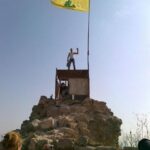
Liberated Beaufort Castle in South Lebanon
Meeting Hamas Thursday evening, July 29, one part of the delegation met the Hamas leader of Beirut and Saida, Abu Achmad Alfatel while the others remained in Beirut to visit Al Akhbar Newspaper. Abu Achmad Alfatel explained the delicate situation of the Palestinian people in Gaza to the participants. Since the elections in 2006, political conditions have tightened through the extended embargo and the general isolation from the rest of the world, which makes daily life very difficult. It seems to him that the western governments were ready to accept the elections, but not the unexpected result - this gives a clear idea of western perception of democracy. Due to the 2009 war in Gaza 70% of the region is destroyed, there exist hardly any infrastructure: ‘We live like in stone age’, … [read more]
Indian Call for the Academic and Cultural Boycott of Israel
3/8/2010
Now, Israel is moving towards the criminal prosecution of those who advocate Boycott, Divestment and Sanctions (BDS) as tools to press Israeli compliance with international law and norms in its Apartheid rule and occupation of the Palestinian people. It is targeting BDS activists for lengthy interrogations and arrest for nonviolent resistance. Its diplomats are considering intervening against BDS successes in localities, such as Olympia, Washington, where a food coop joined the boycott of Israeli goods. This movement, people must understand, is spurned by the failure of governments to bring justice to the Palestinians, a point recently made by Antony Lowenstein. As BDS grows, it’s shaping up as a truly global movement. This is an open call from Indian academics, writers and … [read more]
Beirut and South Lebanon: Sumud visits memorials of martyrdom and victory, Part II
3/8/2010 · Mohammad Aburous
Hezbollah victory exposition in Mlita
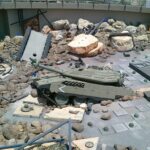
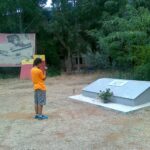
First stop was the village Maghdusheh up the hill above the camp. In 1986, the village had witnessed one of the most crucial battles of the Palestinian resistance against the then pro-Syrien Amal militia. The Palestinian counter-attack to take over the hill put an end to months of a starvation siege imposed by Amal, forcing a cease-fire and free access to the camp. After this short stop, the group moved on to Mlita, which was an important starting point of the Hezbollah guerilla actions during the fights to liberate South Lebanon. There, a war exposition is established in a formal mountain military base of Hezbollah. Destroyed and abandoned tanks, canons, armored cars and weapons of the Israeli army and the collaborator South Lebanese army are exposed. Resistance weapons, tunnel … [read more]
Beirut and South Lebanon: Sumud visits memorials of martyrdom and , Part I
3/8/2010 · Mohammad Aburous
Bild
The first station was the Market of Sabra. Sabra is a poor district of Beirut, which has merged together with the Palstinian refugee Camp Shatila. In Sabra, the population is mixed: Lebanese of all confessions, Palestinian and other poor foreigners live there. Sabra and Shatila are considered as one and the same place, in particular when mentioning the 1982 massacre. At Sabra Market one can find “everything”. The deeper you go into the long market street, things become cheaper and more illegal. The delegation headed from there to Shatila. Different than Ein El Hilweh, Shatila camp is accessible. No checkpoints and ID controls by the Lebanese army are present. The camp was demilitarised in the context of the end of the Lebanese civil war in 1991. Nevertheless, the situation of the … [read more]
Film workshop hunts every-day-life in the refugee camp
30/7/2010 · Elisa, Ulrike & Mohammad
Bild
In this way, the teenager, also making his own short film, will show the place which formed his personality and options: the camp. Along with two selected teenagers, the every-day-life of youth in the camp is to be shown. By this the audience can get an impression of the situation, the daily struggles and they ways and means to succeed them. The arrival of Arab Lotfi, the Lebanese film maker and the leader of the work shop meant the actual beginning of the workshop. A summarized presentation of the film concept and a discussion with Ms. Lotfi took place. Teams were formed to cover the themes. For the first shooting days, two teams were to collect images inside the camp, while the third was to deliver scenes of the surroundings, the surrounding fences and from the hill above. After an … [read more]
Sumud gives first signals of solidarity and starts film workshop
30/7/2010 · Elisa Wiener and Mohammad Aburous
Bild
Straight after the arrival work began. The missing facilities for the multi media centre were purchased. After a first get together, Nashet organised a tour through the Camp. Those delegation members who had already taken part in the mission 2009 were immediately recognised by the inhabitants who welcomed them warmly. This first tour through the Camp allowed for an important impression of the Camp’s intensive political history and present. Posters and pictures of martyrs are everywhere, as well as symbols of Palestinian organisations and banners with political slogans. The Camp means to leave Lebanese normality. Palestine starts here. During the tour, the delegation stopped for a short visit in the PFLP office. It was welcomed by spokesman Abu Bassel who gave an introductory speech … [read more]
One state solution advancing
28/7/2010 · Willi Langthaler
In total some 1,000 people attended. There was the Arab left represented by personalities like Omar Barghouti, the coordinator of the campaign for Boycott, Disinvestment and Sanctions (BDS), Jamal Jumaa of Stop the Wall, Heidar Eid (by video link from Gaza), a political leader of the campaign to lift the blockade, recognised across the factions, or Abd el-Latif Gheith, chairman of the prisoners support association Adameer from Jerusalem (also by internet transmission) – to name only a few. Ahmed Saadat, leader of the PFLP lingering in Zionist jail, sent an address. A good portion of the participants came from Abnaa el-Balad, “children of the land”, the engine of the committee for a secular democratic state. There were also several Jewish Israeli partcipants like the professors Ilan … [read more]
Topic
Archive