Homs: Pyrrhic victory
A sad balance sheet
19/5/2014 · by Wilhelm Langthaler
The Syrian government is celebrating its apparent victory over the armed insurgency in its former capital. But Syrian society pays a price too high. One only needs to look at the appalling pictures of destruction caused by years of siege and indiscriminate artillery bombardment. It stands as symbol for the ravaging of the Syrian social fabric which is even worse than the physical one and without perspective to be healed.

1. Militarily and in an immediate sense also politically the success of the government cannot be denied. But it is to be noted that it became possible because of a negotiated withdrawal and not a full-fledged capitulation. This shows how difficult it is for the government to advance militarily and that this does not mean a pacification of the situation.
2. The democratic left insisted that the better solution would have been a ceasefire and pacification leaving the militants in place this opening up spaces for dissent. In this way they would have been turned into a civil political opposition as they had started out three years back. Unfortunately first of all the government continues to be unwilling for such a step and secondly also the rebels seem not ready for that, neither the …
[read more]Saibaba held in costudy
18/5/2014 · by Tapan Kumar Bose
G.N. Saibaba is in judicial custody in a remote place called Gadchiroli in Maharashtra state in western India.
His remand has been extended by the magistrate for another 14 days. Initially he was not allowed to meet people and was not given any assistance which for a person with nearly 90 percent disability was worse than physical torture. He suffers from hypertension and other ailments. His medicines were not given to him.
Now he is in better situation. According to his lawyer, the jail authorities have assigned two persons to assist him. His medicines are being regularly administered to him and his lawyer has access to him in the …
[read more]G.N. Saibaba, Indian democratic leader, kidnapped
Call by the Revolutionary Democratic Front (RDF)
9/5/2014
G.N. Saibaba is an outstanding and widely recognised figure of India’s various movements against global capitalist rule and its Indian representatives. He has been playing an integrative role of struggles ranging from Kashmir to Tamil Nadu and Nagaland, for the rights of different oppressed groups like the indigenous population (Adivasis), the Dalits (Untouchables) or the Muslims and the social rebellion against the impact of neo-liberalism. He holds contacts across the world and has been organising support for international anti-imperialist struggles like the Palestinian one or the Iraqi resistance.

We call upon everybody to send protest messages to Indian diplomatic missions.
Condemn the dastardly clandestine abduction of Dr. GN Saibaba, Joint-Secretary of RDF, by the Maharashtra Police!
Today, the 9th of May, plain-clothed personnel of the Maharashtra Police abducted Dr. GN Saibaba while he was returning home from Daulat Ram College in Delhi University after examination duty. Dr. Saibaba, who suffers from 90% disability and is on a wheelchair, was blindfolded and pushed into a vehicle. After this secretive arrest of Dr Saibaba from within the university premises, it is believed he is being taken to Gadchiroli in Maharashtra by flight. None of his family members were informed and after repeated efforts to contact him, the driver of his vehicle informed the family of his …
[read more]Donetsk People’s Republic
and Russias’s troubles
5/5/2014 · by Boris Kagarlitsky
Following an extensively shortened article by Boris Kagarlitsky, profiled intellectual and political leader of the Russian left. We publish those parts trying to grasp the character of the Donbass popular movement and describing the Kremlin’s fear of a mass movement.
Western politicians know perfectly well that there is no Russian invasion, and this, precisely, is the main international problem for them. To admit as much means admitting that the government in Kiev has gone to war on its own people. To speak of the Donetsk Peoples Republic as an independent political phenomenon is impossible, since this would require posing the question of the reasons for the popular protest, and listing its demands. The talk of Kremlin agents and of the ubiquitous Russian troops—who are impossible to discover, but who have occupied close to half of Ukraine without firing a shot or even showing themselves on Ukrainian territory—is playing the same propaganda role against the Donetsk republic as was played in the anti-Bolshevik propaganda of 1917 by stories of …
[read more]Donbass revolt calls for our solidarity
Odessa massacre requires a strong response
5/5/2014 · Borotba
Following the call for solidarity by Borotba, one of the independent organisations of the popular revolt of Ukraine’s southeast, as well as an account on the Odessa massacre committed by Ukrainian ultra-rightist forces. Latter enjoy the support of the new Kiev regime as well as the EU and the NATO. As democrats, social revolutionaries and anti-imperialists we support the Donetsk People's Republic.
A Call for Solidarity
May 8 is celebrated all over the world as a day of victory over Nazism that caused millions of losses and much suffering to many people of the world. However, now we see that neo-Nazism raises its head again. Far-right groups and parties are striving to power in many countries. Their members unleash real terror against the dissenters, migrants, the ‘others’, leftwing and anti-fascist activists.
We have to stop the rise fascism again – that’s our duty to stop it till it is not too late.
On May 2, 2014 in Ukrainian city Odessa neo-Nazis and far-right groups unleashed a real massacre. Far-right paramilitaries burned alive and beaten to death 46 local residents in the ‘House of Trade-Unions’. They brutally finished off the wounded, shouting ‘Glory …
[read more]Support the Donbass revolt, but not with Putin
With a democratic and social alliance against the Kiev regime and NATO
3/5/2014 · by Wilhelm Langthaler
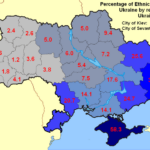
Every international conflict also has a regional or local dimension – this is also true for Ukraine. Quickly, all too quickly geopolitics moves into the centre of attention. But without understanding and considering the socio-political underpinnings, a social revolutionary solution in the interest of the majority cannot be devised.
1. Starting point
The abandonment of the association treaty with the EU last autumn sparked the street protests. This alone bears witness of the social illusions into the EU and western capitalism in general on one hand and the political power of anti-Russian sentiments on the other hand. Both from an economic as well as from a political point of view, the treaty, which implied severing the close relations to Russia, would not have served the interests of the popular masses. In return the EU only has to offer austerity along the lines of the IMF adjustment programmes in southern Europe, further pushing Ukraine into poverty and periphery.
The intensity of the protests can, however, only be explained by taking into consideration the social aspects. The pro-Russian elites commanded a …
[read more]Erdoǧan‘s electoral victory and the end of Turkey as a role model
On the strategic rupture with the liberal middle classes
25/4/2014 · by Wilhelm Langthaler
With close to 50% of the votes the AKP rightly can claim an impressive electoral success despite the alleged involvement of the prime minister and his entourage in corruption. This is yet another evidence for the deep Anatolian roots the AK party could sink during the last decade thanks also to the social and democratic gains – not to speak about the unbroken power of Sunni identity politics. Nevertheless, behind the increased cultural rigidity and authoritarian tendencies there is hidden a deep loss of hegemony especially among the educated middle classes. Conflicts are bound to exacerbate. Turkey has lost its attraction as a model to be followed.
Elections
Black Turkey boldly remains behind Erdoǧan regardless of corruption allegations. The decisive factor for the renewed electoral support is the social and economic ascendancy which also arrived at the Anatolian middle and lower classes – which actually is not a minor occurrence. To acknowledge this it suffices to compare it with the poor performance of all the neighbours. Furthermore there is the historic achievement of peacefully having pushed back the army allowing for a democratic opening which symbolically includes the important right to wear the hijab in public environments.
Corruption, on the other hand, was widespread also before the AKP era. The new rulers just do the same as the old ones – for many even with more legitimacy. Actually, capitalism means systemic …
[read more]Committed to ending the Syrian war
On the spirit emerging from the “All Sides Consultation for Political Solution” in Vienna
26/3/2014 · By Wilhelm Langthaler, Co-convener PeaceinSyria.org
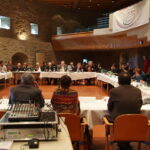
Now that the “All sides Consultation for a Political Solution in Syria” is accomplished and is being recognized by all the participants as a success that deserves continuation, the time has come to draw a balance not only of the conference itself, but also of its wider significance. The very fact that around two dozen people from the most diverse and conflicting backgrounds of Syrian society came together and consulted how to overcome the civil war tearing apart the country is extraordinary. But the spirit emerging from the debates reaches far beyond the objective of this single event, giving hope that a movement for a political solution is gaining momentum.
Exchange among the people – not power-brokering
First of all, let us recall the aim of the “All Sides Consultation for a Political Solution” which took place in the “Peace Castle Schlaining” close to Vienna, Austria, from 7-10 March, 2014. The idea was to give a voice to Syrian society in its full diversity, voices emerging from the people who have been silenced and excluded by the powerful. It was not intended to hold negotiations between the conflicting sides and their global and regional sponsors as has failed in Geneva. A consultative forum of personalities not directly representing the sides involved but indeed representing the societal richness was called upon to explore ways to stop the catastrophic bloodshed.
Thus we were not in search of sophisticated and …
[read more]Call for Peace in Syria
Conclusive Declaration All Sides Consultation for a Political Solution Vienna
21/3/2014 · Initiative for a Political Solution
Syrians coming from most diverse social, educational, political and national backgrounds have gathered on March 8th and 9th in the Castle of Schlaining, Austria, in the framework of an “All Sides Consultation for a Political Solution in Syria” organized by the International Initiative www.peaceinsyria.org.

Driven by deep worries about the deteriorating developments, the disastrous humanitarian situation and the future of the Syrian people, the All Sides Consultation has been searching for what can be done, by means of a political solution, to stop the war, the violation of human rights causing a huge number of victims, the destruction of infrastructure and culture. This solution should help the Syrians to find a new social contract for the construction of a State based on comprehensive national reconciliation and accountability, guaranteeing the rights and freedom for all Syrians.
Recognizing the immense complexity of the situation and the increasing suffering and polarization, following points emerged as consensual during our deliberations. As conveners we are formulating them in the …
[read more]Syrian conference for democratic self-determination
Attempting to give the Syrian people a voice in Geneva
25/1/2014 · by Haytham Manna
"We call together with a large number of forces and national democratic voice for a gathered Conference to restore to the free Syrians their natural right to independent decision-making and to take a political stand together, to build a road map bringing back the role of the political solution as the only way to put an end to the plight faced by the country."
De-railing of Geneva II from the Basic Tracks
I received several letters from friends of the National Coordination Body for Democratic Change – NCB expressing surprise about the NCB’s boycott of the Geneva II Conference in the context of the arrangements, the formula and the conditions in which it is being held. We were particularly the brave defenders of this conference, and we were accused of all manner of sins after our defense of it even from some people who mounted the platform of the delegation of the Coalition on behalf of the Syrian opposition in Montreux.
I wrote in my first notes about “Geneva I”/Geneva Communiqué on 10th July 2012: The Conference has been organised without the Syrians like a meeting of the Security Council, but this negative point has certainly …
[read more]Give a voice to Syrians claiming political solution
Support an all sides’ civil society conference in Vienna
9/1/2014 · International Peace Initiative for Syria
Every day it becomes clearer that the Syrian war cannot be won by anybody with a positive outcome for the Syrian people. With its internal divisions on every side the civil war has reached the state of an unprecedented bloodshed increased by external interventions. Its continuation will only wreak havoc and spread destruction on all levels of society.
Among its main victims there are the democratic rights of the Syrian people, who originally tried to claim these rights by launching a peaceful popular mass protest movement. However their efforts have gradually been thwarted by an increasing influence of sectarian tendencies as well as a growing regional and global involvement.
Together with many people inside Syria and across the world our initiative for Peace in Syria continues to insist (see initial call www.peaceinsyria.org/mission.html) that the only viable solution is a political settlement with a ceasefire paving the way to a transitional government, based on a power sharing agreement between the socio-political, confessional and ethnical blocs maintaining a common State. We are conscious that this is not the ideal solution for …
[read more]Sow the wind and reap the whirlwind!
Declaration by the Anti-imperialist Camp on the WTC bombing
5/1/2014
The imperialist euphoria that had afflicted the world is dead. The wounded beast is crying. The Emperor has declared war as if he were on a science fiction film set. It is not known to whom, it is not known when, but he will send his mercenaries somewhere to revenge the suffered humiliation. The supposedly biggest military power ever has been hit in its most sensitive point: its alleged invulnerability. After the first moments of panic and disorientation, so-called “national pride” is resurging in the USA thus spreading the most terrible imperialist and revanchist sentiments.
In the poorest countries of the world, where hundreds of thousands of people die of hunger and diseases, many have celebrated the massacre of New York. Among those peoples who in the last decades have been suffering from all kinds of humiliations, aggressions, massacres and injustice, many have cheered in occasion of the twin tower collapse. They see the evil where the rich see the good.
Only priests with fully stuffed stomachs could condemn these extreme sentiments of the damned of earth. In fact, the poor and miserable consider the USA and their allies as those responsible for their inhuman conditions of life, for the hopeless barbarism they have to suffer from.
Are they wrong?
The hypocrite governors of the US and the NATO states are threatening, cursing and crying that peace …
[read more]Regime and Islamists sectarian in the same way?
Discussion on the prospective of Syrian Islamism
31/12/2013
Actually we deliberately want to stress the reciprocity and similarity of the phenomenon of sectarianism from both sides of the Syrian civil war though the more suitable notion would be communalism built on a specific group identity.

Responding to the contribution of Anton Holberg: While it is obvious that Sunni Islamism is exclusivist, the regime’s secularist narrative constitutes a hidden, more covered de facto communalism. It is true that it does not refer to religion in the same way as Islamism does. It is fair enough to notice this difference but politically it does not matter much. We know that even the French role model behind the formal façade of egalitarism is de facto very exclusivist and elitist. In Syria everybody starts from the assumption that loyalty to the leading group is not based on ideology or whatever criteria but on communalist group solidarity provoking counter-reactions by the excluded, exploited and oppressed. Unfortunately under the given conditions the popular rebellion was susceptible …
[read more]Syria talks: mission impossible?
What’s new in the Syrian war in the run-up for negotiations in Geneva
27/12/2013 · by Wilhelm Langthaler
1. Chemical arms deal reinstating Assad as an interlocutor of the west acknowledging that he will not be toppled any soon by military means. 2. US-Iran rapprochement. 3. Military advances by the Assad side. 4. Weakening of the popular support base of the insurgency as it falls under Jihadi control. 5. Marginalisation of pro-western military forces. 6. Radical opposition of Saudis to a settlement with Iran expressed in continued support for Jihadism. 7. Assad’s reinforced refusal of any democratic reform or any power sharing compromise with Russian backing.
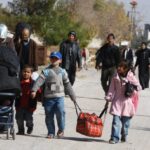
Syria definitely is the focus of conflictivity within the world system. International, regional, political and social fault lines are crossing there producing a tremendous eruption which turned a democratic popular revolt into a sectarian civil war with massive foreign involvement. And the stakes are indeed high, very high. Though the origin and base of the events have been the democratic and social rights of the popular masses, it became also about the redesign of the regional and global order.
Let us try to discern the recent tendencies emerging in this conflict against the background of the preparations for the Geneva talks scheduled for January 2014.
1. Why talks – military solution not sustainable for Washington
The most obvious fact is that the main global power, the …
[read more]Italy in revolt
21/12/2013 · by Leonardo Mazzei
The international corporate media decided to maintain low profile, but for weeks Italy is revolting. From the northeast down to Sicily a movement called “Forconi” (dung forks) is rocking the country. Actually the Forconi, originating from Sicily, are only one component of the mobilization lending their name.

The demonstrations have started out on December 9 called for by autonomous organizations of the toiling masses (peasants, lorry drivers, small entrepreneurs, etc.) but included all sectors of the people hit by the crisis and especially by the sacrifices imposed by the European Union (EU).
Main instrument of struggle are road blocks: In some cases the highway toll stations were occupied completely blocking the traffic. In most cases traffic was slowed down involving private and first of all professional drivers. The mobilization is working: Activists distribute leaflets, drivers stop and sound their horns – now for some two weeks in 135 Italian cities.
In some towns protests were even stronger. In Turin commercial activities were paralyzed for three days. In Genoa and smaller towns …
[read more]Tunisia out of the impasse?
Hoping for an orderly retreat of Ennahda to avoid a return to the old regime
27/11/2013 · by Wilhelm Langthaler
Tunisia was the starting point of the Arab peoples’ revolt. In the central countries of Egypt and Syria, however, the movement is threatened to subside in repression and violence. Again, it is Tunisia, which gives grounds for hope: Ennahda could withdraw from the government without violence paving the way for early elections. Thus the democratic gains could be saved from the threat of a counter-revolution on behalf of the old elites.

Should this succeed - which is by no means certain - Tunisia might serve as a role model. This would strengthen the already-won democratic rights and the path to independent articulation and organization of the subaltern masses against the social elites would be paved.
Let’s try to read the trends in Tunisian society and to draw wider conclusions reaching beyond the small country.
1. Islamists losing influence
Following the overthrow of Ben Ali, the Islamist Ennahda party, a force including several tendencies, emerged as the central power of the new government enjoying a strong relative electoral majority. Although it is true that the popular movement against Ben Ali was influenced by the Left while the Islamists had played only a secondary role, the leading governmental …
[read more]Reading the Iran deal
Global stalemate acknowledged
25/11/2013 · by Wilhelm Langthaler
The beginning détente between the US and Iran is opening a new chapter of global relations. It is not only a game changer in the Syrian arena but will prompt a re-configuration of the Middle East’s setup. Ultimately it indicates another step towards the multi-polar world – but a modest one confirming US supremacy with indirect rule.
The conflict’s background
The base of the antagonism between the West and Iran remains the revolution of 1979 which had a strong anti-imperialist momentum and remains until now one of the most important popular revolutions of the regions or even the world. The Islamic Republic is, however, not a direct, linear, immediate expression of the popular and anti-imperialist tendencies but rather its mediation broken by clerical rule.
We just have to remember the Iraq-Iran war. With its approach of dual containment Washington carefully balanced its proxy support to both sides. The war served the Mullahs as a formidable tool to bend the power of the popular movement having emerged during the revolution.
Take as further evidence the unequal couple of Rafsanjani and Khatami during the …
[read more]Austrian regime confirmed though weakened
Lower classes strengthen social but chauvinist opposition
3/10/2013 · by Wilhelm Langthaler
First: the ruling system has been confirmed though losing consensus. Second: the electoral protest remains within systemic forms. Third: an anti-systemic, let alone social revolutionary momentum continues to be a mere desiderate.
For decades Austria has been ruled by what is called “Big Coalition” between the Social Democrats (SPOe) and the Christian Democrat People’s Party (OeVP) with only few exceptions. Both regime components attempted to claim Merkel’s sweeping electoral victory for themselves. In a certain sense both were right – and nonetheless failed to achieve the same victory.
The SPOe, for two generations the strongest party, is the anchor of (alleged) stability. Regarding culture, social composition as well as social policy they represent the centre. Though this implies to execute the neo-liberal dictates of the European oligarchy (save the bank capital, impose austerity), they try to do this in a way they call equilibrated. If one compares it to other European countries they are even …
[read more]Seven steps to save Italy
The acute governmental crisis and the forthcoming mobilisations
3/10/2013 · Popular Liberation Movement (MPL)
Not pure desperation, but a political calculation has guided Berlusconi’s attempt to let all his parliamentarians resign. What would have happened had he succeeded?
He had anticipated the electoral clash in order to vote with the current voting system still in place. The reason is simple: ungovernability had persisted and the “Berluscones”, given that the M5S (Five Star Movement) is not ready to make any accord with the ruling pro-euro clique, still held the key in hands for the formation of a new government.
As a matter of fact president Napolitano, in name of the dominant European and Italian classes, has done and will do everything in order to avoid elections on the basis of the current electoral law. For the time being they won the game – but for how long is another question.
Their bloc is economically dominant, but no more politically, because it doesn’t enjoy the necessary social consent to govern undisturbed.
Following the …
[read more]Germany: triumph of middle class common sense
Or: full speed towards disaster
26/9/2013 · by Wilhelm Langthaler
First thoughts on the electoral victory of the ruling oligarchy

Appalling victory
From a social revolutionary point of view, Merkel’s sweeping electoral success is abominable. It follows, however, a political-cultural pattern of the German middle classes whose culture dominates the broad masses and therefore also the electorate. It was all about to continue the alleged German Wirtschaftswunder (economic miracle) contrasting with the catastrophe the south is suffering of. The middle classes seek stability and want to avoid taking risk for the weaker eurozone states. But ultimately they do accept measures to prevent the euro crisis from erupting again. Further haircuts for Greece will be unpopular but they trust Merkel to do what is necessary and nothing more. On the surface the petty bourgeois has reason to believe what Merkel has been claiming: …
[read more]